
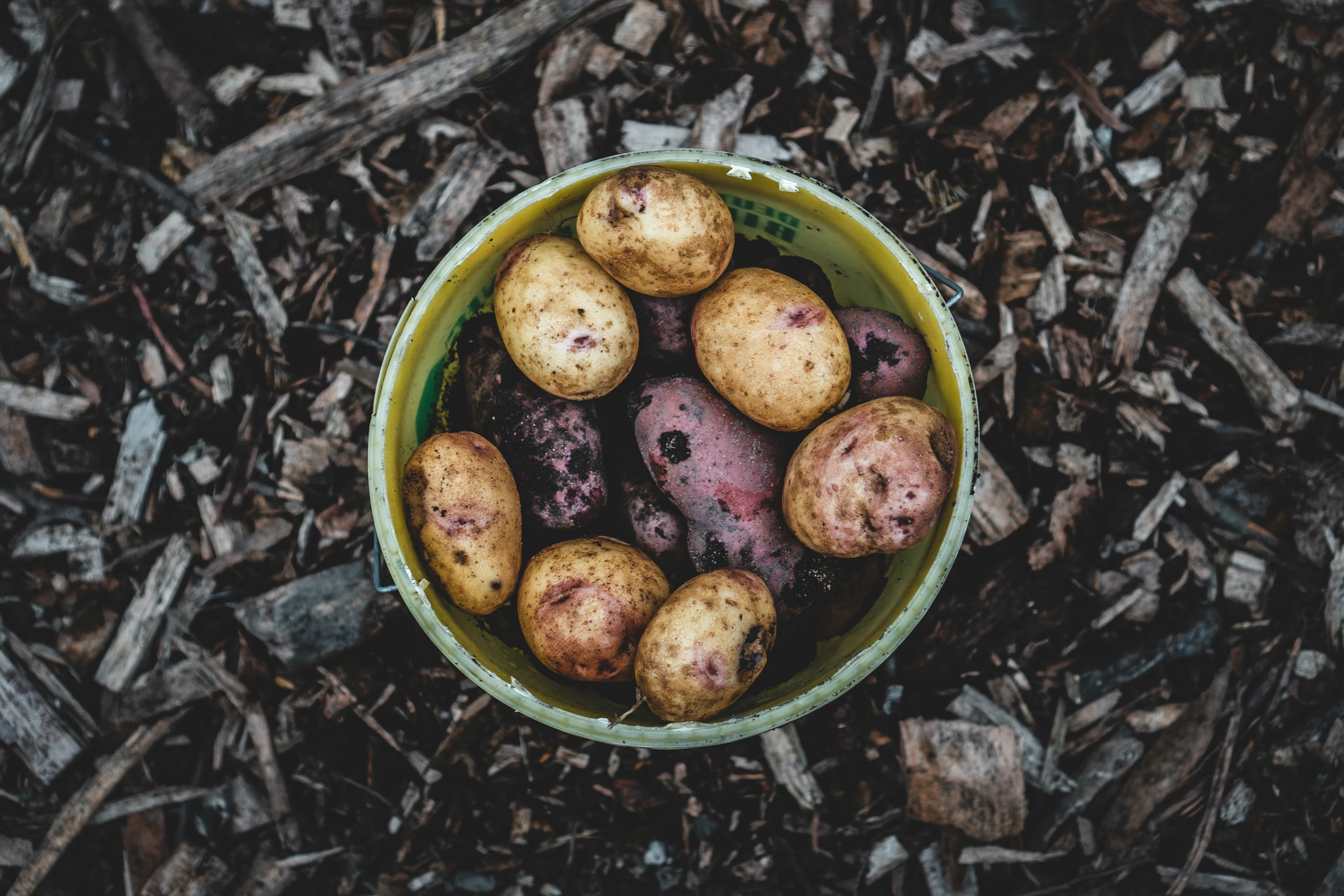
Seed potatoes: a practical guide to selection, storage, and planting
Seed potatoes are the foundation of a successful crop. Choosing the right material, storing it properly over winter, and starting well at planting make the difference between uniform emergence and a season of corrections.
What seed potatoes are
Seed potatoes are tubers intended for planting, selected to support uniform and healthy emergence. They are not the same as table potatoes, even if they look similar.
Why quality matters
The quality of planting material directly affects density, uniformity, and early vigor. A well‑selected lot reduces the risk of gaps and supports a balanced start.
Quality is not just about appearance: uniform material supports uniform emergence, and a uniform crop is easier to manage throughout the season.
In practice, the “best” lots are those that are compliant, documented, and fit the farm’s goals. That is why a good choice starts with clear criteria.
What “top seed potatoes” means
In professional terms, “top seed” means uniform genetics, strong vigor, controlled health status, and traceability. It is not a marketing label, but a set of verifiable conditions.
- Certified seed class + documentation (variety, class, generation, lot).
- Health status and tolerances indicated in documentation.
- Uniform size for consistent emergence.
- Stable storage history (temperature/ventilation) with minimal condensation events.
- Short, sturdy sprouts; long fragile sprouts typically indicate storage that is too warm or too long.
How to choose the right material
- Choose lots with traceability and clear documentation, where available.
- Look for uniform size and healthy appearance.
- Make sure the variety fits your market and local conditions.
If you supply retail, uniformity and storability matter. For local markets or processing, other priorities may fit better. Align the variety with your soil and climate.
A simple framework: market + agronomy + storage
- Market: early, main season, processing (chips/fries).
- Agronomy: drought risk, soil type, disease pressure.
- Storage: short vs. long period, storage stability.
Sizing and density
Sizing affects density and cost per hectare. Too small can reduce early vigor, too large can increase costs without proportional benefit.
- Uniform size = more uniform emergence.
- Set density based on variety and market goal.
- Avoid mixing sizes within the same planting lot.
Checks at reception
At reception, check the lot: appearance, uniformity, documentation, and transport condition. A careful check prevents issues early.
- Firm tubers without visible damage.
- Clean packaging and clear labeling, where required.
- Record lots and keep documents for traceability.
Certification and traceability
In the European Union, seed potatoes can be marketed only if officially certified. Certification includes field inspection, sampling, testing, and official lot labeling.
Rules cover varietal identity, plant health, and minimum size requirements. That’s why clear documentation and well‑separated lots matter.
Well‑known brands and portfolios
In the European market, large portfolios exist with lines for retail, processing (fries or crisps), and traditional consumption. Two internationally known names are Agrico and HZPC, each with extensive lists of varieties and market segments.
- Agrico presents varieties for retail, traditional, processing (fries, crisps), starch and organic segments, and states on their site that they supply certified seed potatoes and technical advice.
- HZPC publishes a variety list by sector (retail, salad, traditional, fries, crisps), maturity, and traits such as skin color or tuber shape.
Important: variety availability varies by country and season. Always check local availability and match the variety to soil and climate.
Indicative variety profiles (examples)
Below are examples commonly described in variety sheets and catalogues. Details can vary by country and official register.
- Bellarosa – very early, often positioned for early fresh market. Commonly described as cooking type B (firm) with good early vigor; oversizing may occur if harvest is delayed.
- Riviera – very early, often noted for early yield and heat tolerance in variety descriptions.
- Arizona – second early, often positioned for uniformity and drought tolerance; suited to fresh market programs.
- Red Lady – a well‑known red‑skin variety for fresh markets, often described with uniform tubers and good handling robustness; some sheets note tolerance to specific diseases.
Quick recommendation map
- Very early harvest: Bellarosa or Riviera.
- Hot/dry seasons: Riviera (heat tolerance) + Arizona (drought tolerance).
- Red‑skin fresh market with heavier handling: Red Lady.
- Uniform packing: Arizona.
Over‑winter storage
Proper storage helps preserve viability. Controlled temperature and ventilation are typically used to reduce losses and keep the planting material in good condition.
On our farm, seed potato lots can be stored over winter in controlled‑atmosphere spaces, with pickup typically available from February, by arrangement.
- Stable conditions help limit dehydration.
- Avoid thermal shocks and large temperature swings.
- Plan pickup in advance for a smooth transition to planting.
Pre‑sprouting (where applicable)
Some farms use pre‑sprouting to speed up and even out emergence. If you do, keep conditions stable and avoid rough handling.
Preparation and planting
Before planting, seed material should be handled carefully to avoid damage. Gradual acclimatization and a well‑prepared seedbed support uniform emergence.
Planting depth and spacing depend on variety, soil type, and production goal. A well‑prepared seedbed supports uniform tuber set.
Common mistakes
- Planting into cold soil without acclimatization.
- Mixing sizes and lots in the same field.
- Rough handling that causes tuber injuries.
- Improper storage with large temperature swings.
Quick checklist
- Variety suited to market and area
- Uniform size and appearance
- Traceability and documentation, where required
- Storage in controlled conditions
- Careful handling before planting
If you want to compare varieties, request updated technical sheets and talk to a local agronomist.
FAQ
Can I use table potatoes as seed?
Generally, it is not recommended. Seed potatoes are selected for planting and support more uniform emergence.
When can lots be picked up for planting?
Depending on schedule and availability, typically from February.
What if the lot is not uniform?
Talk to your supplier and separate sizes where possible. Uniformity helps emergence and planning.
Conclusion
Seed potatoes are essential for a strong crop. With careful selection, proper storage, and good preparation, you improve the chances of a healthy and uniform start.
Need seed potatoes?
We provide seed potatoes with autumn sign‑up and over‑winter storage, with pickup typically from February. Contact us for availability and a recommendation suited to your farm.
Contact us