
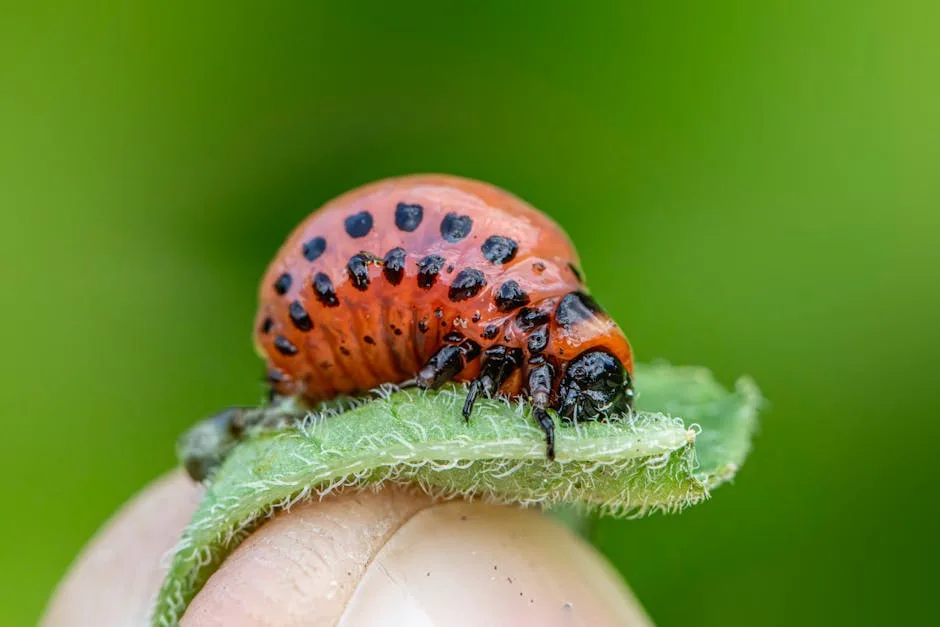
Early-Stage Larvae vs Late-Stage Larvae: Why Timing Matters in Potatoes
In protecting potato crops from larval pests, timing is everything. The difference between applying treatment on young larvae (L1-L2) and mature larvae (L3-L4) can mean the difference between an effective intervention and a costly, ineffective one.
Understanding Larval Stages
Colorado potato beetle larvae go through four developmental stages (L1-L4) before becoming adults. Each stage has distinct characteristics:
| Stage | Size | Duration | Characteristics |
|---|---|---|---|
| L1 | 1.5-2 mm | 2-3 days | Dark red, grouped on leaf undersides |
| L2 | 3-4 mm | 2-3 days | Red-orange, start to disperse |
| L3 | 6-9 mm | 3-4 days | Orange-pink, intensive feeding |
| L4 | 10-15 mm | 4-6 days | Intense orange, maximum leaf consumption |
Note: Sizes and durations are indicative and vary with temperature, variety, and local conditions.
Foliage Consumption by Stage
Here is what really matters: the distribution of foliage consumption during larval development:
| Larval Stage | % of Total Consumption | Leaf Area Consumed |
|---|---|---|
| L1 | ~2% | ~1 cm² |
| L2 | ~5% | ~3 cm² |
| L3 | ~18% | ~10 cm² |
| L4 | ~75% | ~40 cm² |
In practice, most foliage consumption occurs in the L3 and L4 stages. This is the critical window worth avoiding.
Why Early Larvae Are Easier to Control
1. Thinner Cuticle
L1-L2 larvae have a much thinner and more permeable cuticle, allowing contact insecticides to penetrate more efficiently. As larvae grow, their cuticle becomes thicker and more resistant to chemical penetration.
2. Less Fat Tissue
Mature larvae accumulate fat tissue that can sequester and metabolize toxins. Young larvae lack these reserves, making them more susceptible to insecticide effects.
3. Higher Concentration at Contact
Due to their small size, L1-L2 larvae receive a relatively higher dose of insecticide relative to their body weight. In L4 larvae, the same amount of product is diluted in a body 10 times larger.
4. Predictable Feeding Behavior
L1-L2 larvae remain grouped near the hatching site, on leaf undersides. Mature larvae disperse throughout the plant, making uniform coverage much more difficult.
Consequences of Delayed Treatment
Yield Losses
Waiting until the L3-L4 stage can lead to:
- Severe defoliation before treatment becomes effective
- Substantial yield reductions in severe cases
- Compromised tuber quality (smaller size, reduced dry matter content)
Higher Treatment Costs
- Need for higher doses for effectiveness
- Possibility of requiring repeated applications
- Use of more expensive products with more aggressive action
Resistance Risk
Larvae that survive late-applied treatments can develop resistance and pass this trait to subsequent generations. Treatments on early larvae have higher mortality rates, reducing selection pressure for resistance.
How to Identify the Optimal Treatment Timing
Visual Monitoring
Starting in May, inspect the field 2-3 times per week:
- Look for orange eggs on leaf undersides (laid in groups of 20-60)
- After 4-9 days from laying, check for L1 larvae presence
- L1-L2 larvae are small and reddish, grouped on leaves
Ideal Treatment Window
| Window | Stage | Expected Efficacy |
|---|---|---|
| OPTIMAL | L1-L2 (majority hatched) | 90-98%* |
| Acceptable | L2-L3 mixed | 70-85%* |
| Late | L3-L4 | 40-60%* |
*Efficacy figures are indicative and depend on product, dose, pest pressure, and application conditions.
Choosing Insecticide Based on Stage
For Early Larvae (L1-L2)
- Chlorantraniliprole (Coragen) – highly effective, stops feeding quickly
- Spinosad – organic option, excellent on young larvae
- Bacillus thuringiensis (Bt) – biological, requires ingestion, works well on L1-L2
For Mixed or Late Stage Larvae (L2-L4)
- Higher-dose combinations – upper-limit doses may be necessary
- Products with strong contact action – to compensate for thicker cuticle
- Rotation of modes of action – essential for preventing resistance
Practical Strategy: Action Calendar
| Period | Action |
|---|---|
| April-May | Install pheromone traps for adult monitoring |
| May-June | Inspections 2-3x/week for eggs and L1 larvae |
| At L1-L2 detection | TREATMENT within 24-48 hours if conditions allow |
| 7-10 days after | Check efficacy and assess need for second treatment |
Factors Influencing Larval Development
Temperature is the main factor determining development speed:
- At 15°C: larval cycle lasts ~25 days
- At 20°C: larval cycle lasts ~18 days
- At 25°C: larval cycle lasts ~12 days
- At 30°C: larval cycle lasts ~9 days
Values are approximate and may vary with local populations and microclimate.
In warm periods, the treatment window on L1-L2 can be just 3-4 days. Frequent monitoring becomes critical.
Practical Tips for Treatment Success
- Apply early morning or evening for better adherence
- Ensure uniform coverage, including leaf undersides
- Use adequate water volumes (200-400 L/ha depending on plant development)
- Avoid applications before forecasted rain
- Check forecast for at least 4-6 hours of dry weather
Conclusion
The difference between treatment applied on L1-L2 larvae and one applied on L3-L4 is enormous: efficacy over 90% versus under 60%, foliage consumption of 7% versus 93%, and significantly different costs. Regular monitoring and rapid action at first larval detection are the keys to success in potato crop protection.
Do not wait to see visible damage – when it becomes obvious, you have already lost the optimal intervention window. Treat early, treat effectively.
This article is for informational purposes and does not replace professional agronomic advice. Always follow product label instructions and local regulations.