
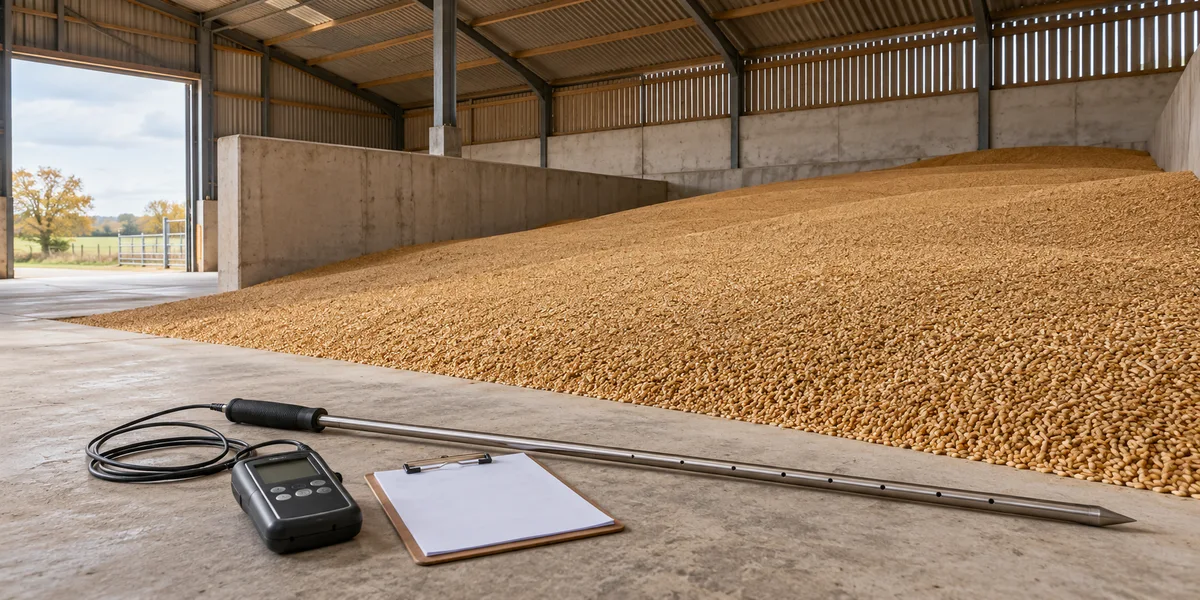
Stored wheat in October: how to check that cooling is working
An article by the Agrico-M team. Agronomic information is general; technical sources are identified in the article where cited. Contact our team to suggest a correction. Contact
Wheat inside a store can remain warm while October mornings turn cold. Check fixed points within the grain, connect temperature readings with moisture observations from the same area, and assign any local rise for investigation. For commercial milling or feed wheat stored in Romania, the useful outcome is a documented decision: continue cooling, check the installation or investigate an affected area separately. This guide covers autumn checks after harvest, including teams working in Brașov, Covasna or Harghita. Those regional examples are not reports of measurements in those counties. Wheat retained for sowing has additional quality requirements that need their own records.
Which lot details should accompany the first check?
Identify the wheat and its position within the store before assembling the monitoring record. Attach the harvest or intake date, intended market and existing results. Draw a simple map of safely accessible measuring positions. A new reading becomes useful when another person can compare it with the same position in the previous check.
Our suggested map includes the store identifier, lot boundaries, moved areas and direction of airflow. If another delivery is added, retain the connection between the records. Do not assign an older delivery temperature to newly added grain. The Agrico-M products page provides business context; use the actual lot documents for its storage decision. Give the buyer requirement its own field, separate from a technical cooling benchmark.
Where and how often should temperature be measured?
Choose a route that can be repeated safely, and mark the positions on the store map. In a system blowing air through wheat, include the area that cools last. A convenient reading near the fan should not become the evidence that the whole lot has cooled. Keep the individual results visible when reviewing progress.
AHDB temperature monitoring guidance uses a calibrated probe, repeated locations and, for blowing systems, usually about 0.5 m below the surface between ducts. Its British monitoring and cooling benchmarks appear below. Confirm their use for your variety, lot and installation; the calendar is not a Romanian legal requirement.
| Check | AHDB benchmark for commercial wheat | How to use it |
|---|---|---|
| Temperature | Every few days until target; then weekly | Keep point-by-point comparisons. |
| Post-harvest cooling | Below 12°C within 3–4 months | Compare against the actual harvest date. |
| Winter cooling | Below 5°C by the end of December | Verify the result in the actual installation. |
How do you distinguish stable moisture from a local change?
Compare measurements obtained by a consistent method at identifiable locations. When a rise appears, ask for the reading and its cause to be checked before it disappears into a store-wide average. Keep the initial result, repeat check and action agreed with the store manager together. This makes the reason for the decision available to the next shift.
AHDB cereal moisture guidance calls for immediate drying at ≥18% moisture and investigation of a local rise of ≥2 percentage points within a week. These are stored-cereal management benchmarks, rather than universal buyer specifications. In a fictional calculation, 14% followed by 16% at the same point is +2 percentage points: 16 minus 14. The example explains recording a difference; it does not certify the lot for storage. Note any change of sample, meter or measuring location separately, because it makes the comparison inconclusive.
Why does a running fan not prove that cooling is complete?
Confirm the result within the wheat according to the installation plan, alongside information about the ventilation air. Fan hours record activity; closing the action also needs a verification reading. If the same areas remain warm, request a technical check and keep the issue linked to those positions open until the result has been assessed.
ARVALIS guidance from July 2026 explains the need for a final check and for allowing for air warming through the fan. Measure downstream air at the installation’s designated points and compare it with the approved target. Record settings and airflow direction so that any adjustment remains traceable.
Give the technician the map, actual grain depth, duct positions, reading history and settings used. Ask what follow-up will demonstrate that an intervention worked. Rechecking the marked positions after an agreed cooling cycle is easier to verify than an unexplained instruction to leave the air running. Keep the written conclusion with the readings that support it. A control arrangement copied from a different store needs an assessment of the equipment before anyone applies it.
What happens when a point becomes warmer or wetter?
Open a deviation record for the affected position and assign someone to take it forward. Retain the first observation, repeat reading and decision together. If the information does not yet support a conclusion, specify the remaining check, the responsible person and its planned completion time. Make that work visible during the shift handover.
- Identify the point on the map and retain the original result and unit.
- Repeat the measurement using the verified method; record any method changes.
- Notify the responsible person and record requested checks for water, airflow and local grain condition.
- Write down the authorised action, operator and next check time; close the deviation only with its verification result.
For technical assessment, provide precise descriptions: position, time, any unusual smell noticed without exposure, visible water or a changed grain surface. A photograph is not a laboratory result. If testing is requested, identify the sample and chosen laboratory within the site procedure. Cooling and the appearance of grain do not constitute a delivery compliance certificate. AHDB storage risk management distinguishes monitoring from corrective action; preserve that distinction in the record so another person can see what has actually happened.
What should the next shift receive?
Hand over an explained working status and an action assigned to a person. Keep the map, readings and decisions together. The next colleague should recognise the area without repeating a telephone conversation and know what observation can close the check or require another assessment.
Alongside the value and unit, our suggested fields include probe identifier, instrument verification, time, moisture method and changes to the installation. Mark an inaccessible position as unchecked; an empty cell may look like an administrative omission. Record who can authorise movement of the grain so that lot identification remains consistent. When an area is moved, preserve the earlier reference and give the new location its own identifier.
Within the season record, storage documents can connect with the wheat plant-density and tillering record, while field observations and store readings remain distinct. For a later commercial enquiry, send relevant results with their dates. Do not present an older check as evidence of the lot’s current condition.
Which questions arise during an autumn check?
These answers help the team use the record consistently. They concern documentation and communication between the store, technical lead and buyer. Equipment settings remain specific to the actual installation, and a ticked field does not replace the result needed to justify closing an issue.
Is outdoor air temperature enough?
Record it as ventilation context alongside measurements within the wheat. Label every value clearly: outdoor air, air after the fan or a point within the lot. The report reader can then distinguish a cold morning from a grain reading and retrieve the right measurement when discussing the result.
Can an average close a problematic point?
Keep the position open until it has a documented follow-up check. An average may be useful in a summary, but our proposed record retains the local observation separately. Beside the repeat result, explain the action taken between measurements and identify who assessed whether that action resolved the issue.
How can checks avoid entry into dangerous areas?
Use the access arrangements and measuring points defined in the site procedure. HSE advises avoiding confined-space entry where the task can be done from outside. Escalate an inaccessible position to the responsible person; this sheet does not authorise entering a silo or improvising an intervention.
Does the sheet establish buyer acceptance?
The sheet describes the check and retained results. Attach agreed specifications, documents and requested tests for the acceptance decision. A clear record helps the teams exchange useful information, but the commercial decision still needs to identify the lot and the evidence used, including the dates of the checks.
Which record can you download for the next check?
Download the wheat monitoring PDF, English page. It provides room for a point map, temperature in °C, moisture in %, a repeat result and the action owner. It is a printable sheet for manual completion, without automatic calculations or acceptance certification. Test the field names and handover process with the team before adding it to the regular register.
For a commercial discussion about a wheat lot, send the intended use and available documents to the Agrico-M team.
Sources and scope
- AHDB - Cooling targets for grain storage - Undated current web guidance; Temperature monitoring; Grain cooling targets (short-to-long term).
- AHDB - Grain storage moisture targets for cereals and oilseed rape - Undated current web guidance; Grain moisture targets for cereals; Moisture monitoring in stores.
- ARVALIS - Ventiler les céréales dès la récolte - 16 July 2026; Quelques recommandations; Quelle durée pour bien ventiler ?.
- AHDB - Hazards and their management during longer-term grain storage - Undated current web guidance; An introduction to HACCP; hazard management table.
- HSE - Workplace safety and welfare - Undated current web guidance; Confined spaces.
Primary sources checked on 20 October 2026. British and French recommendations are commercial technical benchmarks, not Romanian rules or local observations. The record layout and arithmetic example are editorial proposals.
Note: adapt this guide to the lot, installation, buyer requirements and local procedures with the competent responsible person. Drafted with AI assistance for review; the image is an AI illustration.