
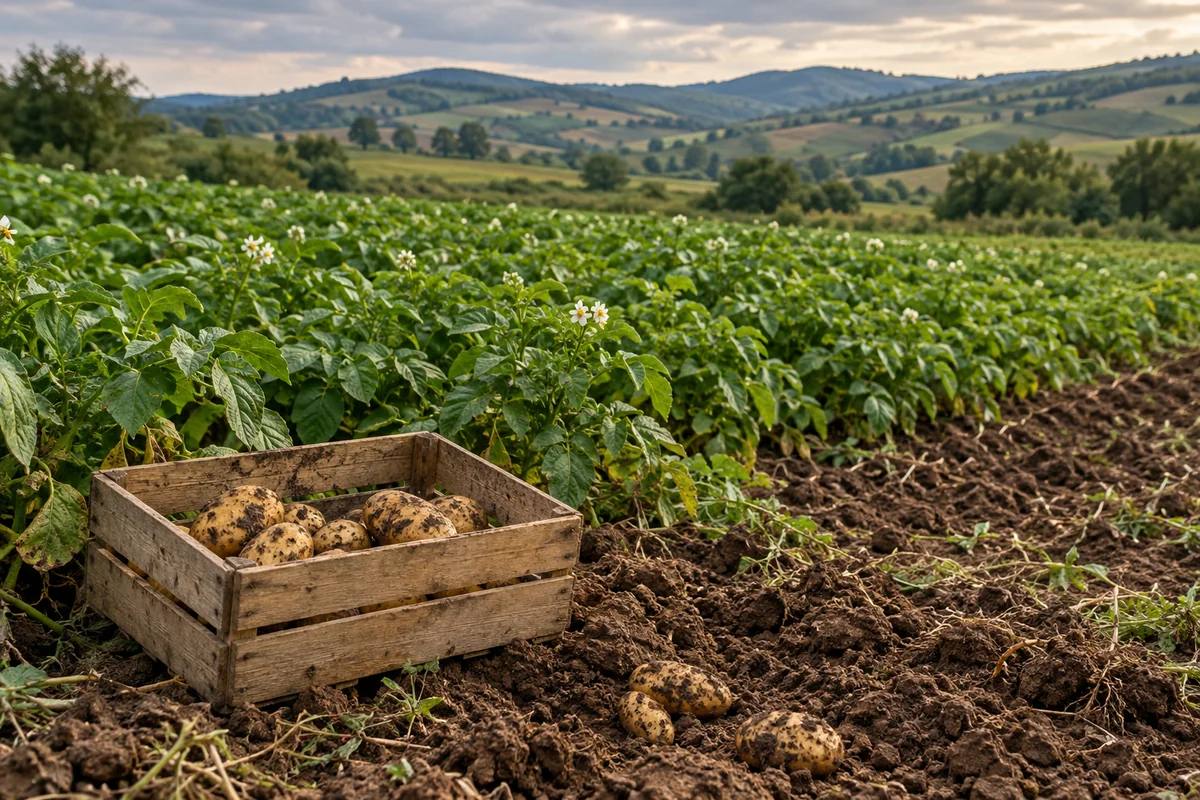
The potato year in Transylvania: a practical plan
An article by the Agrico-M team. Agronomic information is general; technical sources are identified in the article where cited. Contact our team to suggest a correction. Contact
An illustrative calendar for commercial potatoes in Brașov, Harghita and Covasna should follow crop stage, available water and lot destination. Plan backwards from buyer requirements to planting material, then track the same lots through storage. These measurable checks support ware, processing and, separately, seed potatoes throughout the production cycle.
Which practical reference points can you use?
Measure what can change the operation: soil condition, water balance, tuber temperature and storage development. Commercial reference ranges are typical and need confirmation for your variety and facility. Keep ware, processing and seed records separate, because a regime suited to planting material may alter the cooking quality of a frying consignment.
| Check and decision | Source / basis |
|---|---|
| Before planting, separate ware, processing and seed plans and enter the final requirement on the sheet. | John J. Burke — Growing the Potato Crop |
| FAO gives an indicative potato water need of 500–700 mm/season; this is evapotranspiration, not an irrigation dose. | FAO — Crop water needs |
| Conversion: 1 mm over 1 ha = 10 m³; a hypothetical 10 mm deficit equals 100 m³/ha before system losses. | Hypothetical example; editorial calculation or specification. |
| Burke describes greater harvest injury below 7°C and advises avoiding soil above 16°C; confirm conditions for the crop. | John J. Burke — Growing the Potato Crop |
| For seed, AHDB describes cooling by 0.25–0.5°C/day after loading when crop condition permits. | AHDB — Seed potato storage |
| Check seed stocks every few days initially and at least weekly once holding temperature is reached. | AHDB — Seed potato storage |
| For seed, AHDB aims for less than 1°C variation across the store to limit condensation; compare probes with a hand thermometer. | AHDB — Seed potato storage |
| For fresh ware, Burke gives a 4–7°C holding range; confirm variety, duration and cooking quality before choosing the regime. | John J. Burke — Growing the Potato Crop |
What does the buyer require before planning?
Decide whether the crop is intended for sale soon after lifting, staggered deliveries or storage. Record size and culinary requirements before discussing variety and seed. Work backwards: delivery requires an acceptable lot; that lot requires suitable harvesting and handling; those depend on a monitored crop.
Keep the preferred delivery window separate from a confirmed commitment. If the intended use changes, revisit harvesting and storage as well as the sales column. Include the field, area, responsible person and unresolved information on the same sheet so the team shares one current version of the plan.
What does field history show after harvest?
Close the season with observations for different parts of the field, rather than one overall impression. Where did water collect? Where did clods, difficult traffic or damaged tubers become concerns? Keep dated photographs linked to locations.
These records inform discussion of rotation, drainage and subsequent field work. Soil analysis and fertiliser history provide different information from the appearance of the crop, so avoid replacing them with guesses. Before scheduling an operation, ask whether the soil can support it and which problem it addresses. An extra pass without a clear purpose can consume time without improving preparation.
What resources should you reserve before the season?
Calculate seed requirements from the planting arrangement agreed with the technical lead, rather than a universal density found online. Confirm variety, grade and required documents for the ordered lot. Check machinery, labour and, where relevant, water availability.
A fallback plan can identify who authorises a delay and which alternative work remains possible. Monitor existing stored lots separately; planning the next crop does not remove the need to follow their condition and intended use. Obtain written confirmation of significant commercial details and distinguish an enquiry from a confirmed reservation.
What should you check in planting material?
At intake, connect labels and documents to the physical seed lot. Inspect tuber condition and preserve lot identity throughout preparation. Resolve damage, uneven sprouting or discrepancies before mixing material or beginning planting. Preparation must reflect variety and physiological condition; last year’s method is not automatically suitable.
Plan handling so prepared seed is not left waiting without an agreed approach if weather changes. Record the inspection date, observation and person authorising the next step. Use current supplier recommendations and local technical advice for the practical details.
When is the soil ready for planting?
Compare actual conditions with the requirements for sound planting: workable soil, machinery set for the seed received and a realistic operating window. Check depth, distribution and seed integrity over a trial section. If results are uneven, stopping to adjust is more useful than reproducing the issue across the whole field.
Record the actual date and seed lot for each field. These details help interpret emergence and subsequent development. A gardening recommendation from another country is not a compulsory planting date for Transylvania; soil, terrain and seasonal differences require field checks.
How do you track water and tuber growth?
Check seed stocks every few days initially and at least weekly once holding temperature is reached.
When are harvest conditions suitable?
Before mobilising the full team, examine tubers from several locations and check how the skin withstands handling. Distinguish a crop intended for rapid consumption from one intended for storage. Foliage colour or elapsed days alone cannot answer every readiness question.
Start with a controlled section, inspect cuts and bruising, then adjust the handling flow. Prepare lot identification and the receiving area before the first load arrives. When a problem appears, record where in the process it occurs so a possible cause can be changed and the outcome checked again.
How do you match storage to destination?
At intake, preserve lot separation and record condition, including unconfirmed information. Set the storage plan according to intended use, variety, lot condition and available facilities. Follow changes rather than relying only on a reading from the first day.
At dispatch, connect observations to the received lot and buyer requirements. In the season review, ask which decisions worked, which information was missing and what should be checked earlier. The next calendar then rests on records rather than memory. Older foreign guides can explain physical storage processes, but their chemical recommendations do not establish authorised uses in Romania.
What questions arise in practice?
Is seasonal water need the irrigation amount?
Build a balance from effective rainfall, soil reserves and crop use. Irrigation fills the deficit that the system and soil can safely accommodate. Retain measured inputs and the estimation method so the plan can be updated after material weather changes.
Can one store serve every destination?
Check whether lots and required regimes can be separated. Destination, variety, duration and health define the storage plan. If two requirements cannot be met together, agree another delivery order or physical separation before loading.
How do I keep field-to-lot traceability?
Use the same identifier in field, harvest, box and delivery records. When splitting a lot, record new codes and quantities. This allows a field-zone issue to be followed into storage without mixing every consignment’s history.
What changes if wet spots appear in store?
Locate the zone, check temperature and airflow, and inspect for rot. Segregate affected material and adjust ventilation after assessment. Record the location and development at the next check to distinguish an airflow pocket from a general store problem.
How do you use the downloadable sheet?
Download the PDF booklet in this page’s language and use the article page identified in the link. Enter actual readings beside the references and retain the sheet with its sample or lot record. On the next visit compare the same units and record the change that supports the team’s decision.
- Link buyer requirements to field and lot code.
- Enter water, stage and conditions for each operation.
- Follow the lot through harvest, storage and delivery.
Download the PDF checklist (7/9)
Which guides support the next check?
- Potato varieties: choosing for market requirements
- Red Lady, Bellarosa, Red Fantasy, Arizona and Picasso
- Potato larvae: identification and label-led decisions
Discuss lot requirements with the team
Sources and evidence
Documents checked on 20 October 2026; use the relevant sections in each source.