
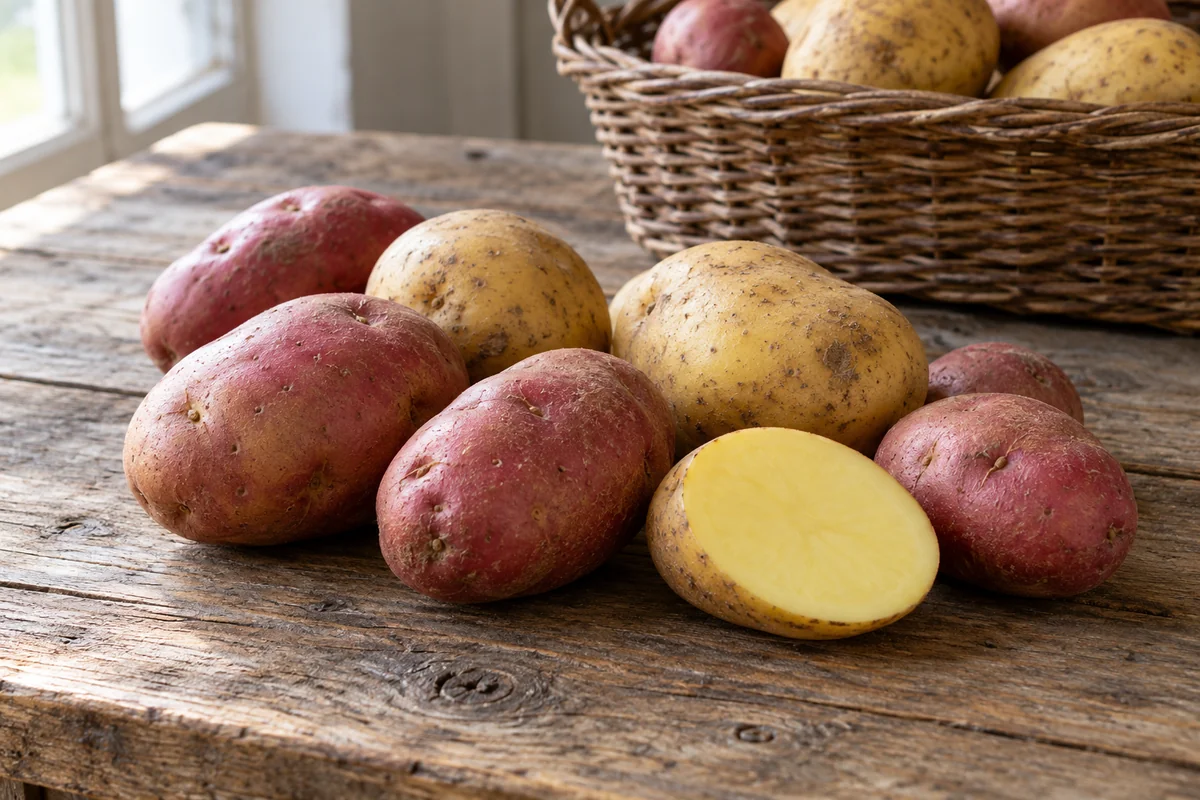
Red Lady, Bellarosa, Red Fantasy, Arizona and Picasso
An article by the Agrico-M team. Agronomic information is general; technical sources are identified in the article where cited. Contact our team to suggest a correction. Contact
For commercial production or buying in Covasna and Brașov, define use before comparing Red Lady, Bellarosa, Red Fantasy, Arizona and Picasso. Check breeder profiles and confirm requirements on a lot sample. The table and comparison sheet turn differences in maturity, grade and cooking behaviour into a shortlist for the planned season and delivery.
Which practical reference points can you use?
Select criteria you can confirm at delivery: identity, grade, cooking behaviour and cost per usable tonne. Variety descriptions provide a starting point, and dry-matter figures are catalogue values. Keep the actual sample result and its conditions separate, making comparisons traceable without promising identical performance in every field or season.
| Check and decision | Source / basis |
|---|---|
| Red Lady: Solana describes red skin and fairly firm cooking; test the required appearance and texture on a sample. | Solana — Red Lady |
| Bellarosa: EUROPLANT describes very early–early maturity and a large-grade tendency; confirm the buyer’s size fraction. | EUROPLANT — Bellarosa |
| Red Fantasy: medium-early, predominantly firm cooking profile; verify delivery timing and the cooking sample. | EUROPLANT — Red Fantasy |
| Arizona: Agrico lists 17% dry matter; enter the measured lot result separately. | Agrico — Arizona |
| Picasso: Agrico lists 20.8% dry matter; confirm using a comparable sample. | Agrico — Picasso |
| Agrico lists Arizona as cooking type AB and Picasso as B; assess frying separately from boiling. | Agrico — Arizona |
| Buying example: for a 45–75 mm specification, compare accepted mass in that fraction rather than gross yield alone. | Hypothetical example; editorial calculation or specification. |
| Hypothetical example: 1,000 lei/t with 5% unrecoverable loss = 1,052.6 lei/usable t before other costs. | Hypothetical example; editorial calculation or specification. |
When does Red Lady fit the shortlist?
Solana describes Red Lady as a medium-early ware variety with long-oval tubers, red skin, yellow flesh and a fairly firm cooking character. These points support a discussion about appearance and use, rather than reliable visual identification of a lot.
What should you check for Bellarosa?
EUROPLANT describes Bellarosa as very early to early, with red skin, light-yellow to yellow flesh and early development of large tubers. That can start a discussion about an early red-skinned market requiring larger grades.
How should you assess Red Fantasy?
EUROPLANT describes Red Fantasy as medium early, red skinned, deep-yellow fleshed and suited to longer storage. This raises a different question from simply finding the first early delivery: which product needs to remain available, and under what conditions?
Which use should you assess Arizona for?
Agrico classifies Arizona as second early, with yellow skin, light-yellow flesh and rather firm AB cooking character. Its sheet marks industrial fries and crisping suitability as unsuitable.
What must be confirmed for Picasso?
Agrico describes Picasso as a maincrop variety with yellow skin and red eyes, long dormancy and storage suitability. This profile can inform a discussion about deliveries following storage, but does not by itself determine how long goods remain acceptable.
How do you build a useful comparison?
Start with two or three requirements without which the offer cannot work, such as cooking behaviour, delivery window and grade. These are working criteria, not hidden scores for declaring a winner. Exclude an option only for an explained incompatibility; mark missing evidence as requiring verification.
Then request lot information for the remaining options. For an early red-skinned enquiry, a Bellarosa discussion can start with maturity and grade. For red-skinned goods after storage, a Red Fantasy discussion includes the storage plan. These examples illustrate the order of questions rather than automatic ordering recommendations.
How do you link resistance to the local concern?
Do not turn “resistant” into a general promise against disease. Sheets use specific organisms, pathotypes and their own rating systems; one favourable characteristic says little about unrelated concerns. For a field with a known history, record the identified problem and request an exact interpretation of the current sheet.
A blank field does not establish resistance. Comparing two numbers from different catalogues does not create a reliable ranking either. Crop protection needs diagnosis and applicable local advice, rather than a generic treatment list attached to a variety name. When information appears contradictory, clarify the version and context before deciding.
What should you confirm before ordering?
Before accepting an offer, confirm the exact name, intended use, lot identifier, relevant sample outcome and delivery terms. For seed, add the requested category and documentation; for ware, include the receiving specification. If a supplier proposes substitution, revisit the criteria instead of accepting equivalence from colour alone.
Keep responses on one sheet and identify the decision maker. After use, record what worked in the actual circumstances without generalising one lot to every season. Today’s comparison then becomes a better starting point for the next enquiry.
For an enquiry that can be compared across suppliers, use the market-requirements guide. For field operations, use the crop-stage planning guide.
What questions arise in practice?
Does red skin imply the same use?
Check maturity, texture and performance in the intended preparation separately. Colour supports the commercial description, but buyer requirements also include graded appearance and sample performance. Compare lots using the same tests, retaining origin and conditions on the sheet.
Does an early variety guarantee delivery timing?
Confirm planting, actual development and harvest conditions for the offered lot. Maturity class supports planning. Before promising availability, update the commercial date using seasonal observations and grading, packing and transport capacity.
How do I compare cooking samples fairly?
Choose samples representing the offered lots and use the same preparation method. Record texture, colour and performance relevant to the buyer. Keep lot identity on every result so that a successful sample can be linked to the actual delivery.
What if comparable local results are missing?
Use breeder cards for a shortlist, then request samples and lot data. Keep decisive criteria written down. A transparent comparison can support selection without inventing farm yields, local resistance or a guaranteed variety ranking.
How do you use the downloadable sheet?
Download the PDF booklet in this page’s language and use the article page identified in the link. Enter actual readings beside the references and retain the sheet with its sample or lot record. On the next visit compare the same units and record the change that supports the team’s decision.
- Enter profile, use and decisive criterion for each variety.
- Add actual sample results and offers for the same grade.
- Confirm lot and availability before ordering.
Download the PDF checklist (9/9)
Which guides support the next check?
- The potato year in Transylvania: a practical plan
- Potato varieties: choosing for market requirements
- Potato larvae: identification and label-led decisions
Discuss lot requirements with the team
Sources and evidence
Documents checked on 20 October 2026; use the relevant sections in each source.