
Colorado potato beetle: larval stages and scouting
An article by the Agrico-M team. Agronomic information is general; technical sources are identified in the article where cited. Contact our team to suggest a correction. Contact
In commercial potato crops in Covasna and Suceava, time decisions by tracking eggs, small larvae and crop stage along the same route. Inspect more often as hatch advances or populations approach a decision level. The table distinguishes scouting intervals from American intervention references, while the downloadable sheet supports comparisons during crop growth.
Which practical reference points can you use?
Stage changes and fresh feeding, interpreted with potato phenology, provide the useful evidence. Separate counts show whether the population is shifting towards larger larvae or a new hatch is starting. These references come from American commercial extension; use them in a local agronomic discussion and enter the next visit on the sheet.
| Check and decision | Source / basis |
|---|---|
| Colorado potato beetle has 4 larval instars; photograph larvae and record small/large categories separately. | Penn State Extension — Colorado potato beetle |
| UMass suggests weekly scouting during activity and a return in 3–4 days near the decision threshold. | UMass Extension — Colorado potato beetle |
| UMass intervention references are 0.5 adults, 4 small larvae or 1.5 large larvae/unit; confirm local economic applicability. | UMass Extension — Colorado potato beetle |
| Keep plant or stalk units consistent between visits; a unit change requires a new data series. | UMass Extension — Colorado potato beetle |
| Penn State identifies a 15–30% egg-hatch timing window for early larvae; establish need and authorised use first. | Penn State Extension — Beetle timing |
| Tracking example: 20 hatched eggs among 100 observed = 20%; count eggs rather than unequal-sized egg masses. | Hypothetical example; editorial calculation or specification. |
| If large larvae dominate, separate old injury from fresh feeding when evaluating the result. | Penn State Extension — Colorado potato beetle |
| Record flowering and tuber development at every visit; crop sensitivity changes interpretation of the same population. | Penn State Extension — Colorado potato beetle |
How do you recognise eggs and larvae?
University sources describe yellow-orange egg clusters beneath leaves, reddish larvae with dark spots along their sides and adults with black stripes on pale wing covers. Use the features together rather than relying on one colour in a photograph.
If an image does not allow identification, keep that uncertainty in the record. Do not label every small organism on a potato plant a Colorado beetle larva; the same plant can host organisms unrelated to the problem being investigated.
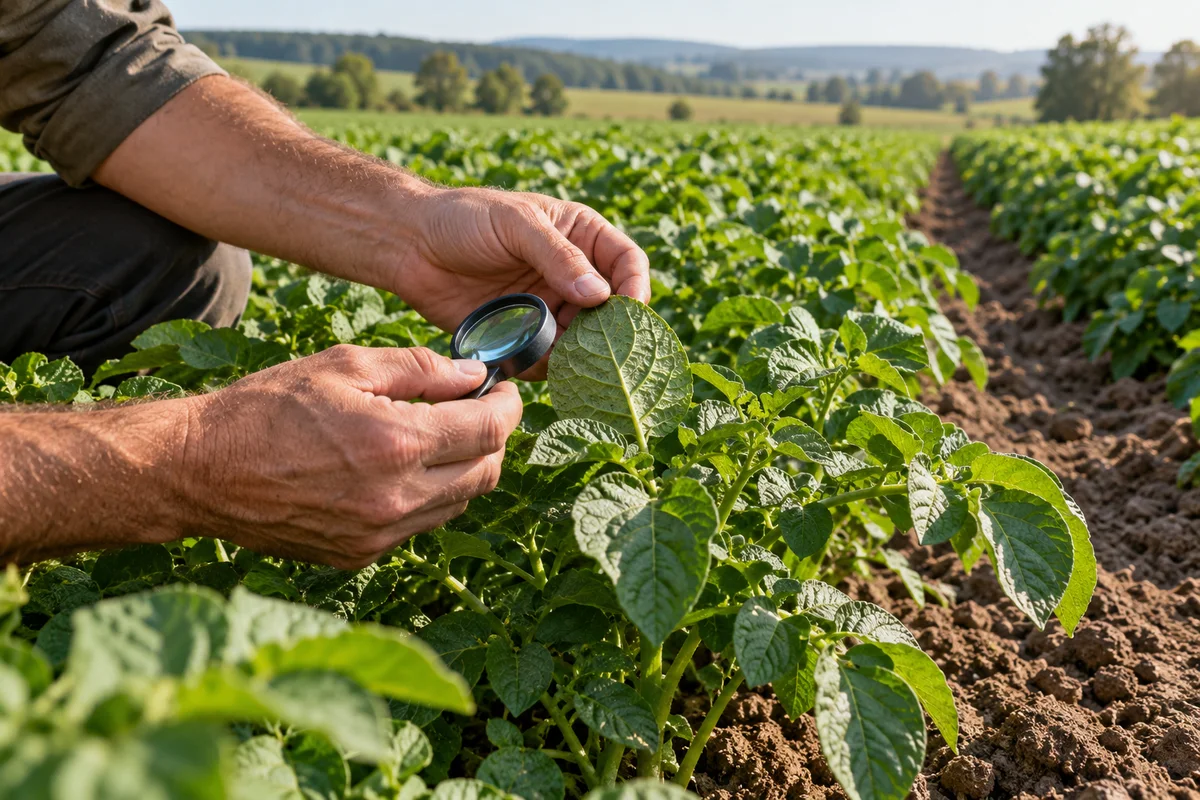
Repeat observations need categories that the team can use consistently. Separate eggs, small larvae, large larvae and adults, adding “unidentified” where necessary. Photograph representative examples for discussion with an adviser. The AI image accompanying this article illustrates inspection practice; it is neither an insect identification plate nor evidence of an infestation on a real farm.
Why record potato growth stage too?
Colorado potato beetle has four larval instars. EPPO’s biological account describes temperature-dependent development and mature larvae leaving plants to pupate. Do not turn an assumed age into a fixed number of days after first discovery. “There are no larvae on the leaf I photographed” does not, by itself, mean the whole population has disappeared. Examine other locations before reaching a conclusion.
Record potato development separately: canopy size and condition, proximity to flowering and the information available about tuber formation. Ask your agronomist to interpret injury in the context of this particular crop. Two fields with similarly sized larvae can require different assessments if the plants are at different stages or affected by other stresses. Larval colour does not summarise economic risk.
How do you repeat the inspection?
Cornell recommends walking the field and recording adults, small larvae and large larvae separately. For your own record, document the route, number of plants and areas examined so the inspection can be repeated. Include the interior and edge rather than stopping at the first damaged plant.
If the route changes, say so before comparing totals. An explained method is more useful than an apparently precise number without context.
At each stop, examine both leaf surfaces and distinguish apparently fresh from old injury. Do not combine eggs, larvae and adults into a single “insects” total, because that loses the information needed to follow population development. If a category was not assessed, record that instead of entering zero. Zero means you looked and found none; an omitted category means something different.
When should you return to the field?
A record showing eggs and small larvae may justify a different revisit from one showing old injury without confirmed activity. Plan the next inspection with your adviser using field development and weather, rather than an automatic interval between treatments.
The record should explain why another observation is needed and what question it will resolve. Repeating the same photograph provides little information unless it addresses a new question.
For example, ask whether larvae have appeared at previously egg-bearing stops and whether the share of plants with fresh injury has changed. This is an example question, not an Agrico-M field observation or treatment threshold. Separate “activity is increasing” from “intervention is necessary”; the latter requires assessment of the crop and available options. A biological trend should not automatically become a commercial recommendation.
How do you compare two records?
Consider a fictional example used only to explain data: the first record shows small larvae on four of twenty plants examined; the second shows them on eight of forty. The raw count doubled but the proportion stayed the same.
Without the denominator, the team might incorrectly report a doubling of infestation. An equal proportion does not prove that conditions were unchanged either: routes, sampled plants, stages, fresh injury and time between visits still need comparison. This example establishes neither a threshold nor a sampling protocol.
Define the counting unit too. An egg mass is not an individual egg, and a plant bearing larvae does not tell you how many larvae it carries. Put these observations in separate columns and keep the convention consistent between observers. Mark an estimate as an estimate rather than mixing it with a direct count. Before handing over the record, ask another person to explain the column headings. If interpretations differ, correct the form before the next visit, while doing so is still straightforward.
What must be checked before intervention?
If you find holes in tubers or organisms in soil, return to diagnosis before applying this guide’s logic. Wireworms are not later stages of Colorado potato beetle. Hand your adviser the record with its sampling denominator, photographs, observed categories and remaining question. A useful assessment ends with a clear next step: additional identification, documented monitoring or a justified action whose result can be checked.
What questions arise in practice?
Do more large larvae mean a new hatch?
Compare eggs and small larvae too. An increase in large larvae may show development of the same cohort. Stage-based records help distinguish population development from a new hatch and support timing of the next inspection.
Can I schedule work by a fixed date?
Schedule inspection using observations and weather, then update the plan in the field. Hatch and development vary between seasons and fields. A work calendar remains useful when it includes the check that can change the timing of the next action.
Why separate larval counts from defoliation?
Larvae describe the current population; defoliation shows feeding accumulated over time. Record both and inspect new leaves. A damaged leaf remains damaged even if later activity falls, which changes how you assess an intervention result.
Can I use the American threshold directly here?
Use it as an external commercial reference and seek interpretation for variety, stage, injury and local costs. Verify any Romanian product use separately. Retain both the reference source and the reason for the decision adopted in your field.
How do you use the downloadable sheet?
Download the PDF booklet in this page’s language and use the article page identified in the link. Enter actual readings beside the references and retain the sheet with its sample or lot record. On the next visit compare the same units and record the change that supports the team’s decision.
- Choose a route and enter stage-based counts.
- Add crop stage and fresh-feeding observations.
- Set the next check and its reason.
Download the PDF checklist (5/9)
Which guides support the next check?
- Potato larvae: identification and label-led decisions
- Potato IPM: a practical plan for the whole season
- The potato year in Transylvania: a practical plan
Discuss field observations with the team
Sources and evidence
Documents checked on 20 October 2026; use the relevant sections in each source.