
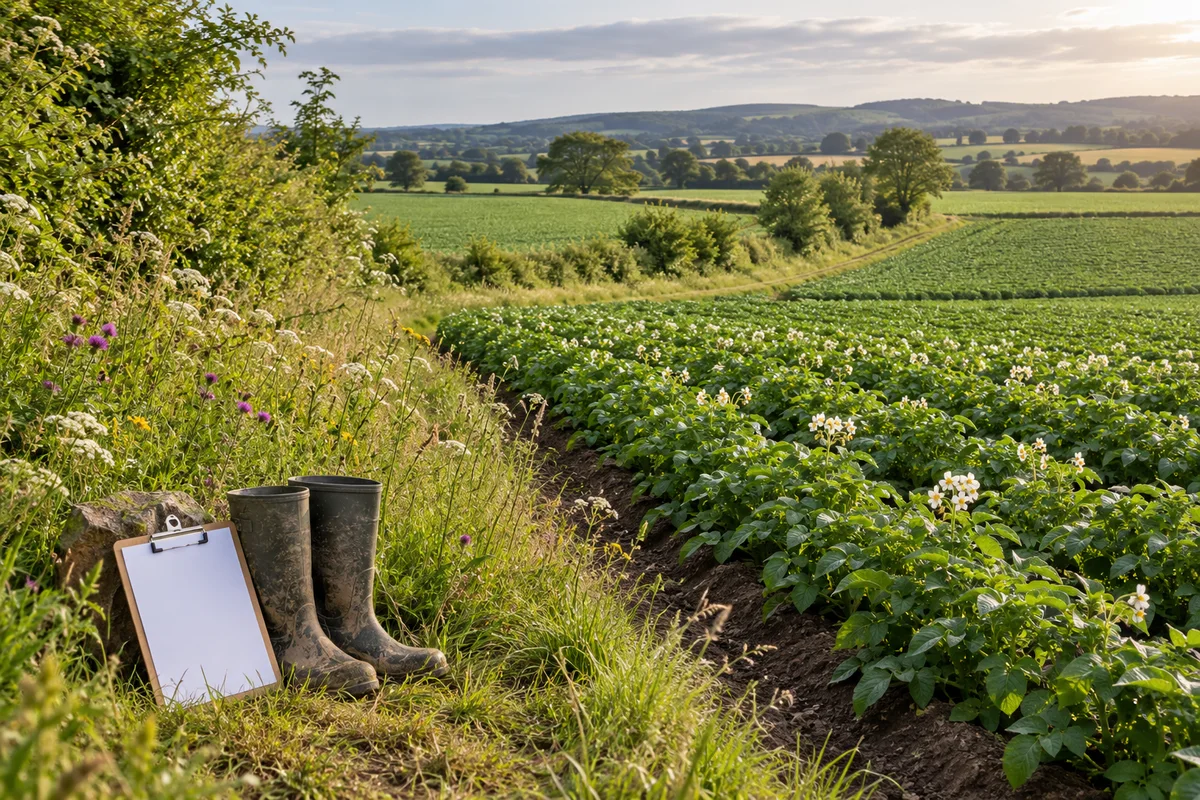
Potato IPM: a practical plan for the whole season
An article by the Agrico-M team. Agronomic information is general; technical sources are identified in the article where cited. Contact our team to suggest a correction. Contact
For ware, processing or seed potatoes in Transylvania, build protection around field history, planting material and seasonal observations. Select measures for the confirmed problem and check results at the same points. The IPM sheet connects prevention, monitoring and post-harvest evaluation in a plan the team can use together.
Which practical reference points can you use?
An integrated plan names the risk, its measurement and the result that would change the measure. Keep foliage, soil and tuber indicators separate. The table provides commercial references and interpretation rules for the working sheet. Assess field history and rotation against the identified pest and field conditions, with monitoring matched to the problem.
| Check and decision | Source / basis |
|---|---|
| Check grass history and previous damage before choosing a field; obtain wireworm risk assessment. | AHDB — Wireworm field research |
| If soil testing is negative, retain catch and damage history; limited sensitivity can miss low populations. | AHDB — Wireworm field research |
| In potatoes, track the AHDB 50–75% canopy-closure stage as a slug observation point. | AHDB — Slug monitoring |
| One slug/trap is AHDB’s British potato risk reference under active conditions; confirm risk for the local crop. | AHDB — Slug monitoring |
| For stored seed, AHDB reports minimal bacterial multiplication at 4°C or below; segregate wet/diseased lots. | AHDB — Seed potato storage |
| If a treatment is justified and authorised, compare its action group with previous interventions; changing brand does not automatically change group. | Penn State Extension — Colorado potato beetle |
| Example: 8 injured plants among 40 = 20% affected plants; that is not 20% defoliation. | Hypothetical example; editorial calculation or specification. |
| After intervention return to the marked route and assess new feeding/activity separately from old signs. | UMass Extension — Colorado potato beetle |
How does field history change the planting plan?
European Commission principles include rotation, suitable planting material, hygiene and protection of beneficial organisms. Turn them into a potato plan by starting with a map and existing evidence: previous crops, confirmed problems, poorly drained areas and observations from the last harvest. Do not fill gaps with assumptions. An incomplete history should prompt a check rather than an automatic recommendation.
Prepare one page for each field. Include planned variety, intended market and the questions affecting land or cultivation choices. A tuber problem last year, for example, requires a different discussion from suspected defoliation. Decide who confirms the diagnosis before planting and which planting-material documents must be retained. An accessible plan is more useful than a large folder with no connections between its records.
How do you separate problems during growth?
IPM covers diseases and weeds as well as insects. Keep separate categories so that a canopy change is not immediately attributed to a pest. Record field code, date, route, plant count and the symptoms or organisms actually seen. Where a suspicion needs diagnosis, add photographs and a concrete question rather than a premature conclusion. Keep the observation separate from its interpretation.
Return using a comparable method and explain any change in route or procedure. An extra observation in a hotspot is useful but must be distinguished from general sampling. The linked article on Colorado potato beetle stages explains separate egg, larva and adult records. For a soil problem, leaf inspection alone is inadequate. Choose the observation method that fits the question rather than forcing every diagnosis into the same form.
What observation justifies a measure?
EPA places identification, monitoring and thresholds before selection of a control measure. Ask your agronomist to document which threshold or criterion fits your field and why. Finding one organism does not automatically prove that treatment is necessary. Equally, the absence of a simple number is no reason to postpone an important diagnosis. The criterion should address the situation rather than merely fill a box.
Record continued monitoring as an option too: what information is missing, who will obtain it and what change would alter the decision? These questions prevent an IPM plan from becoming a fixed calendar. Where an overseas source provides numbers, use it for methodological discussion rather than as a Romanian prescription. Thresholds, products and practices may have different contexts and need checking before transfer to another region.
How do you compare control options?
Build a shortlist relevant to the confirmed diagnosis: cultivation or hygiene, physical methods, biological options and, where justified, chemical protection. For each, ask what it addresses, when it is feasible, which resources it needs and what limits it has. A method described in a study is not automatically available, authorised or practical on your acreage. Practical checks should precede selection.
Use a simple farm worksheet: option, intended benefit, limitation, known or unknown cost, responsible person and outcome check. Compare the same objective across options. Reducing risk before planting and stopping activity already present are different objectives. A preventive measure should not be judged as though it were a rescue treatment, and a laboratory result should not be presented as a result achieved on the farm.
How do you check mode of action?
IRAC classifies insecticides by mode of action. Two different commercial brands may belong to the same group; changing the name on a container does not demonstrate a change of mechanism. If an adviser proposes a resistance strategy, request the active ingredients and groups alongside the relevant use history. IRAC classification is an information tool, not authorisation to use a product on a particular crop.
Before an application, check Romanian authorised use, current label, field conditions and team responsibilities separately. Record the reason for selection, not just the product name. If performance appears weak, revisit diagnosis and actual conditions; do not infer resistance from a single observation or improvise changes to instructions. Build the strategy with your adviser using evidence and the applicable documentation.
How do you measure the intervention result?
Decide in advance what you will measure on return and at which locations. Compare organism activity, fresh injury and crop condition with the baseline. Record intervening changes in weather, other work or sampling method. Improvement after an intervention does not alone establish how much of the result it caused. Ignoring that limitation produces overconfident conclusions for the following season.
If a fair comparison is impossible, record the limitation. A missing photograph or changed route cannot be repaired by presenting a retrospective estimate as a measurement. End with an explained conclusion: objective achieved, result unclear or further diagnosis needed. Each can lead to a useful next step if its reason is clear. Do not turn every assessment into a justification for automatically repeating the intervention.
What should change for next season?
At season close, connect harvest observations to field records and check whether the tracked problem was correctly identified. Separate actual costs from estimates and avoid attributing a yield difference to one measure without an adequate comparison. Choose a concrete improvement for next year: preplant diagnosis, a clearer form or a person responsible for revisits. Continuity makes the plan useful; yield promises do not.
What questions arise in practice?
Is IPM simply choosing another product?
The plan starts with field, seed and prevention, then uses observations to select a measure. Compare options against the specific problem and record results. A justified chemical step belongs within a sequence that can include non-chemical measures.
Does a negative test erase field history?
Retain the result with method, date and test sensitivity. Compare it with previous injury and sample type. A negative result may reduce a suspicion, but assessment of hard-to-detect organisms needs all those sources of evidence.
How do I compare two measures?
Choose the same indicator, unit and comparable zones. Record growth stage and weather, then follow change. Label a hotspot-only sample separately so that sampling differences remain visible in the conclusion.
What should I retain after harvest?
Preserve the link between field, crop observations and harvested-lot defects. Record the measure used and what remains unresolved. Select a concrete change for the next plan, with an owner and a check, so the record is put to use.
How do you use the downloadable sheet?
Download the PDF booklet in this page’s language and use the article page identified in the link. Enter actual readings beside the references and retain the sheet with its sample or lot record. On the next visit compare the same units and record the change that supports the team’s decision.
- Enter field history, planting material and priority risk.
- Set the indicator, unit and local decision criterion.
- Record the measure and post-intervention comparison.
Download the PDF checklist (6/9)
Which guides support the next check?
- Potato larvae: identification and label-led decisions
- Colorado potato beetle: larval stages and scouting
- The potato year in Transylvania: a practical plan
Discuss field observations with the team
Sources and evidence
Documents checked on 20 October 2026; use the relevant sections in each source.